
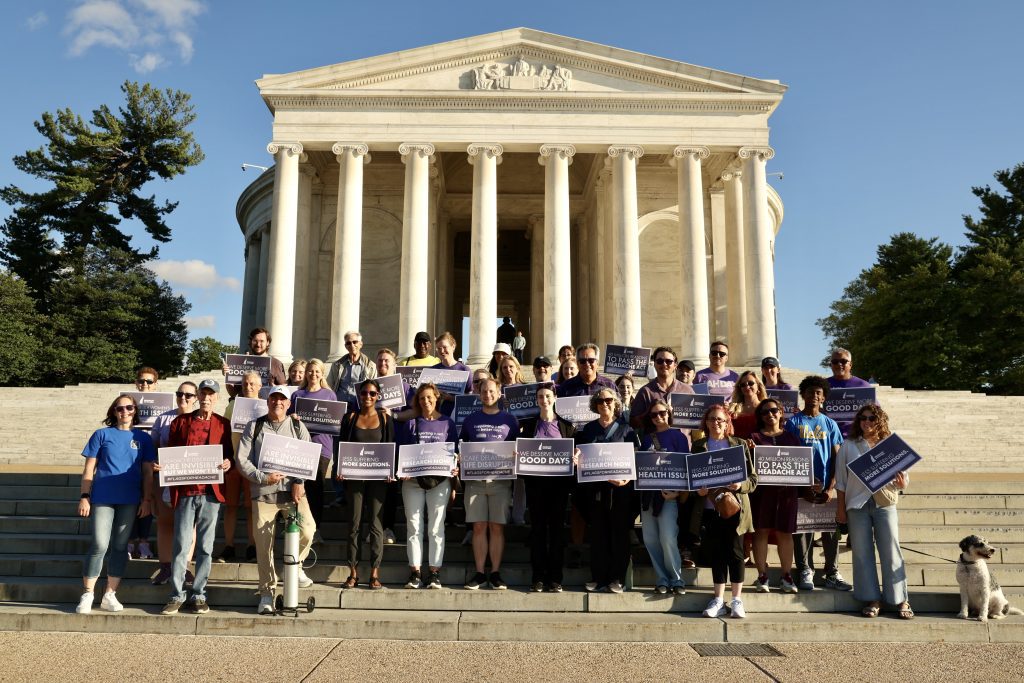
After a rainy day in Washington, D.C., the sun finally came out for us.
On Tuesday evening, as the sky cleared over the Flags for Headache installation, patients, families, advocates, and supporters gathered among more than 30,000 purple flags for something different than a rally, a press conference, or a policy event.
We gathered to remember.
The Walk for Headache Health brought our community together to honor the lives lost to migraine and headache disorders, recognize the profound mental health impact these diseases can have, and remind those still living with them that they are not alone.
The evening began at the Flags for Headache installation at Raoul Wallenberg Mixed Use Field, where thousands of purple flags stretched across the landscape, each representing people whose lives have been touched by migraine and headache disorders. For many attendees, simply standing among the flags was emotional. What can often feel like an invisible disease suddenly became visible.
Before the walk began, our community celebrated an extraordinary accomplishment. Chris Charrett-Dykes of Chronic Migraine Awareness completed his remarkable journey of walking 1,000 miles in 100 days for migraine and headache awareness. His walk represented perseverance, resilience, and a commitment to ensuring that people living with these diseases know they are seen.
The evening was presented in partnership with The Headache Alliance, the Alliance for Headache Disorders Advocacy, Chronic Migraine Awareness, and Clusterbusters. Together, we created a space for grief, reflection, connection, and hope.
“Tonight, we gathered in a different spirit,” said Julienne Verdi, Executive Director of The Headache Alliance and the Alliance for Headache Disorders Advocacy. “We are here to honor the people we have lost to migraine and headache disorders. We are here to honor those whose lives were cut short, those whose suffering was not fully understood, and those whose pain was too often invisible to the world around them. We are also here to acknowledge the mental health toll these diseases can take.”
Throughout the program, tributes were read in memory of loved ones whose stories continue to inspire advocacy and action. Each story served as a reminder that behind every statistic is a person, a family, and a life that mattered.
Attendees also heard from leaders and advocates who shared powerful reflections on the realities of living with headache disorders and the importance of building a community where no one suffers alone.
Catherine Charrett-Dykes, Founder of Chronic Migraine Awareness, spoke about the importance of recognition and support.
“The stigma around migraine keeps people from getting the help they need,” she said. “They need to understand migraine is a disease. It can become chronic in months and it can destroy lives. Help is available. You are not alone.”
Billy Dwyer honored the memory of his sister Melissa, who died by suicide after living with chronic migraine and mental health challenges.
“I’m incredibly thankful for this opportunity to carry my sister Melissa’s story forward at the Walk for Headache Health,” he shared. “In the 13 years following her death, our family has worked to share her experience with chronic migraine and the debilitating nature of this disease. We will continue to advocate for a better future for those struggling with headache disorders, fighting for greater access to treatment and research.”
Bob Wold, Founder of Clusterbusters, spoke on behalf of the cluster headache community.
“I am honored to be the voice for the community that is here to memorialize those people from our community that have lost their lives due to their cluster headaches,” he said. “Scientifically, headaches are known as benign. All of the headaches in the lives of those we’ve lost were not benign.”
Together, attendees observed a moment of silence for those who have been lost and for all those who continue to carry the burden of these diseases every day.
Following the program, participants carried signs and candles along the Tidal Basin to the steps of the Jefferson Memorial and back.
The route itself held special meaning.
Thomas Jefferson lived with severe, recurring headaches throughout his life, including during his years of public service. As our nation approaches the 250th anniversary of the Declaration of Independence, his story serves as a reminder that headache disorders have long been part of the American experience.
What must change is how seriously these diseases are recognized, researched, treated, and supported today.
Migraine and headache disorders affect more than 40 million Americans. Conditions such as migraine, cluster headache, trigeminal neuralgia, post-traumatic headache, and new daily persistent headache can profoundly affect every aspect of life, including work, school, family responsibilities, relationships, and mental health.
For many people living with chronic disease, the emotional burden can be just as significant as the physical pain. That reality was at the heart of the evening’s message.
Awareness means recognizing not only the pain people experience, but also the isolation, grief, fear, exhaustion, and uncertainty that can accompany these conditions.
Yet above all, the Walk for Headache Health was about hope.
Hope that research will advance.
Hope that more treatments will become available.
Hope that fewer people will struggle alone.
Hope that families will find support.
Hope that one day these diseases will receive the attention and investment they deserve.
As the walk concluded and participants returned to the sea of purple flags, one message remained clear: this community is strong, compassionate, and determined to create change.
“If you are living with migraine or another headache disorder, you are not alone,” Verdi reminded attendees. “Please do not give up hope. We are fighting for better treatment, better research, better access, better support, and more good days for all of you.”
The Walk for Headache Health was part of the 2026 Flags for Headache campaign, a national effort to make migraine and headache disorders visible, elevate patient stories, and build momentum for change.
The Flags for Headache installation remains open in Washington, D.C. through June 30.
To learn more about the campaign, visit FlagsForHeadache.org.
